SaaS Platforms: Building Software That Scales

SaaS Platforms: Building Scalable Software That Grows With Your Business

Software as a Service has transformed how companies build and deliver digital products. Instead of distributing software through installations or packaged releases, businesses now deliver continuously evolving platforms that users access through the cloud.

This shift has significantly increased expectations for performance, reliability, and scalability. A modern SaaS platform must support thousands of users, process large volumes of activity, integrate with other services, and remain available at all times.

Building systems that can handle this level of demand requires more than functional software development. It requires thoughtful architecture, strong infrastructure planning, and a development approach designed for long-term growth.

What Defines a Modern SaaS Platform

A SaaS platform is designed to deliver software services to multiple users through a centralized online system. Unlike traditional software, which is installed and managed locally, SaaS platforms operate continuously and must support multiple customers simultaneously.

Microsoft describes SaaS platforms as cloud-based applications that allow multiple users to access shared infrastructure while maintaining secure data separation between tenants (Microsoft Azure Architecture Center, 2023).

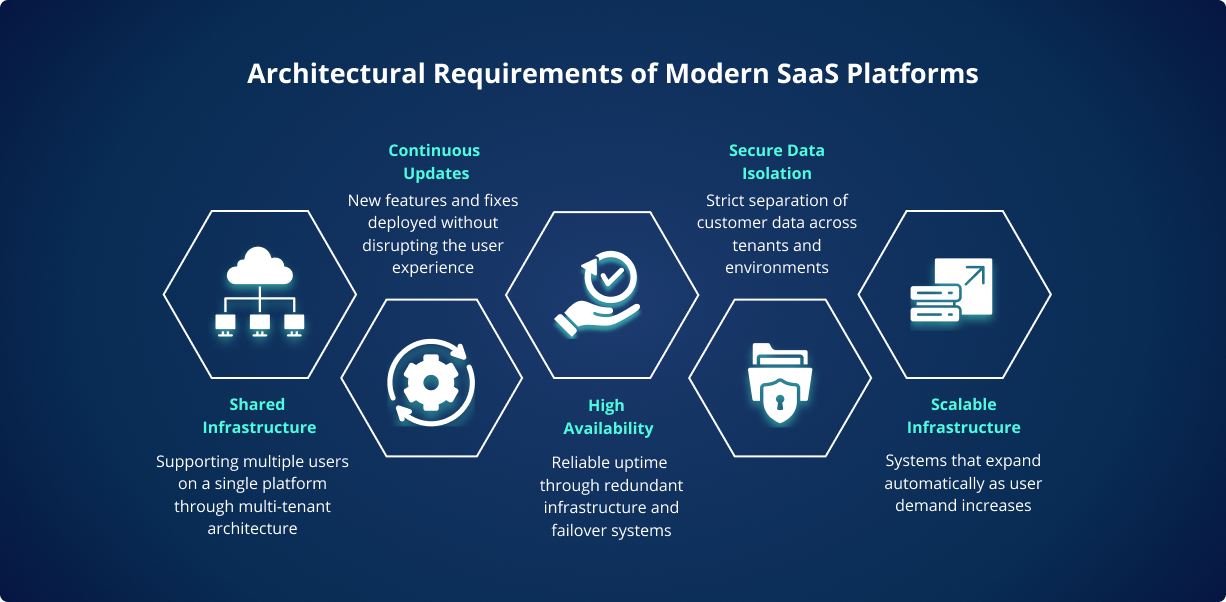
This creates several architectural requirements:
• Shared infrastructure supporting multiple users
• Continuous updates without disrupting the user experience
• High availability and minimal downtime
• Secure separation of customer data
• Infrastructure capable of scaling as usage increases

Because SaaS products operate in real time and serve diverse users, the underlying system must be designed to handle both growth and complexity from the start.

Architectural Requirements of Modern SaaS Platforms

Key Architectural Principles Behind Scalable SaaS Platforms

Successful SaaS platforms rely on a combination of architectural principles that support long-term scalability and reliability.

Multi-Tenant Architecture
Most SaaS platforms use a multi-tenant model, where multiple customers share the same core infrastructure while keeping their data isolated.
Multi-tenancy allows SaaS providers to efficiently allocate computing resources while maintaining strong data isolation and security across customers (Amazon Web Services, 2023).

When implemented correctly, multi-tenant systems significantly reduce operational costs while supporting large user bases.

Cloud-Native Infrastructure
Modern SaaS platforms are typically built on cloud infrastructure. Cloud environments allow systems to dynamically scale computing resources based on demand, ensuring that the platform remains responsive even during periods of high activity.

Cloud-native systems are designed to fully utilize the elasticity, resilience, and automation capabilities of cloud computing environments (Cloud Native Computing Foundation, 2022).

Cloud-native design also improves resilience, allowing systems to recover quickly from infrastructure failures.

High Availability and Reliability
Because SaaS platforms are accessed continuously by users, uptime becomes a critical requirement. High availability systems distribute workloads across multiple services and servers to prevent outages when individual components fail.

As the Google Site Reliability Engineering guide explains, modern distributed systems are designed to anticipate failure and maintain service continuity even when individual components malfunction (Google SRE Book, 2016).

This type of infrastructure ensures that the platform continues functioning even under unexpected stress.

Continuous Deployment
SaaS platforms evolve constantly. Continuous deployment pipelines allow teams to introduce improvements, security updates, and new features without interrupting the platform’s operation.

Continuous delivery practices allow organizations to release software updates more frequently while maintaining stability and reliability (Humble & Farley, Continuous Delivery, 2010).

This enables SaaS companies to innovate quickly while maintaining a stable user experience.

Microservices and API-Driven SaaS Architecture

As SaaS platforms expand, traditional monolithic systems can become difficult to maintain and scale. Many modern platforms adopt a microservices approach, dividing the system into smaller independent services.

Each service performs a specific function and can be scaled independently based on demand. According to Martin Fowler, microservices architecture allows complex systems to be built as collections of loosely coupled services, improving scalability and maintainability (Fowler, 2014).

APIs play an essential role in this environment. Well-structured APIs allow services to communicate efficiently and enable integrations with external systems, partner platforms, and third-party tools.

Together, microservices and API-driven design help SaaS platforms remain adaptable as they evolve.

Security and Compliance in SaaS Platforms

Security is one of the most important aspects of any SaaS platform. Because these systems often manage sensitive customer data, security must be integrated directly into the architecture.

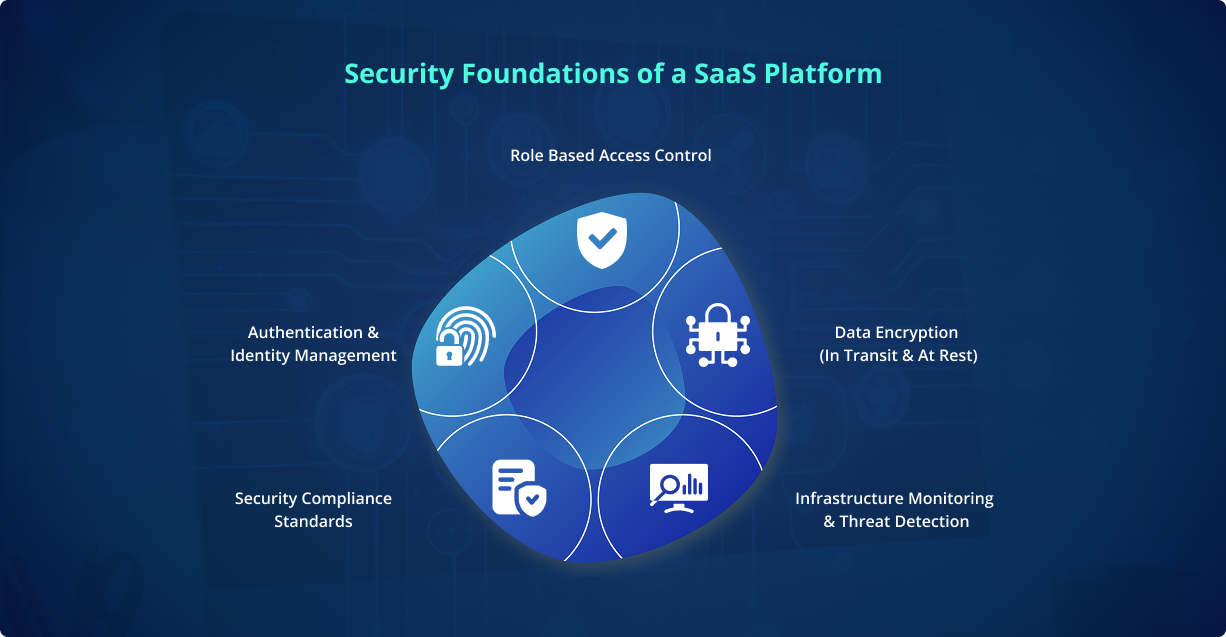
A secure SaaS platform typically includes:
• Robust authentication and identity management
• Data encryption during transmission and storage
• Role-based access controls
• Infrastructure monitoring and threat detection
• Compliance with relevant security standards

By embedding security into the development process, SaaS platforms can maintain trust while protecting user data and platform integrity.

Security Foundations of a SaaS Platform

Monitoring, Observability, and Platform Performance

Even technically capable organizations often mismanage governance.

Treating Governance as a Compliance Checkbox
Implementing policies only in response to regulation limits strategic value. AI governance should be embedded in long-term planning rather than treated as a reactive measure.

Assuming Vendor Compliance Is Sufficient
Using third-party AI tools does not eliminate internal responsibility. Organizations remain accountable for how AI systems operate within their workflows.
Internal AI governance must complement vendor safeguards.

Ignoring Data Governance
AI governance cannot exist without strong data governance. Poor data hygiene or unclear documentation undermines even advanced models.
Data governance and AI governance must operate in alignment.

Deploying Without Monitoring
Focusing heavily on model development while neglecting post-deployment oversight increases risk. Without monitoring, performance degradation may go unnoticed.

Governance ensures AI systems remain aligned with business objectives over time.

How Codora Builds Scalable SaaS Platforms

At Codora, SaaS development projects are approached with a focus on building platforms that remain stable and adaptable over time.

Rather than designing systems that simply meet immediate requirements, the goal is to create infrastructure capable of supporting long-term platform growth.
This approach often involves:

Designing scalable backend architecture that supports growing user demand
• Implementing cloud-based infrastructure for flexibility and reliability
• Building modular services that allow platforms to evolve over time
• Continuously optimizing performance as usage increases

By focusing on long-term architecture rather than short-term solutions, SaaS platforms can grow without sacrificing reliability.

Scaling a SaaS Platform in Practice: The Wopla Example

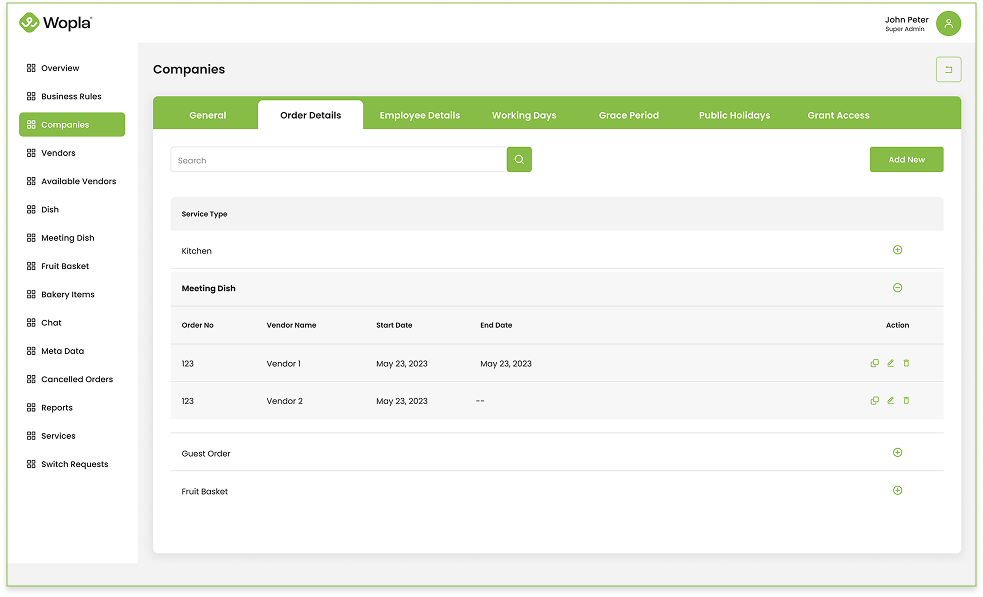
A practical example of scalable platform development can be seen in Codora’s collaboration with Wopla, a rapidly growing digital platform.

As Wopla expanded its platform capabilities and user activity increased, maintaining system stability became increasingly important. Codora worked closely with the Wopla team to support the platform’s development and ensure the infrastructure could scale alongside its growth.

Through careful architectural planning and ongoing technical support, the platform was able to handle increasing operational demand while maintaining a consistent user experience.

Wopla’s continued growth has since been recognized through Gazelle Award recognition, highlighting the success of the platform’s expansion.

saas platforms
saas platforms

Building SaaS Platforms That Scale

As more organizations adopt cloud-based software models, the demand for reliable SaaS platforms continues to grow.

Scalability, security, and performance are no longer optional features. They are essential components of any platform designed to serve users consistently.

Through thoughtful architecture and experienced development teams, businesses can build SaaS platforms capable of supporting both current operations and future expansion.


At Codora, we focus on designing scalable software platforms that remain reliable as products grow. Our work emphasizes strong architecture, resilient infrastructure, and systems built to support long term platform evolution.

If you are building or scaling a SaaS platform, reach out at hello@codora.io to start the conversation.

Author

Get in touch with us

Hello! If you have any questions, concerns, or feedback, we would love to hear from you. Please don’t hesitate to reach out to us via email at Hello@codora.io.

We are committed to responding to all inquiries as promptly as possible.

We look forward to connecting with you!

No, thank you. I do not want.
100% secure your website.
Powered by